ISSN 1674-3865 CN 21-1569/R
主管:国家卫生和计划生育委员会
主办:中国医师协会
辽宁省基础医学研究所
辽宁中医药大学附属医院
主管:国家卫生和计划生育委员会
主办:中国医师协会
辽宁省基础医学研究所
辽宁中医药大学附属医院

Chinese Pediatrics of Integrated Traditional and Western Medicine ›› 2026, Vol. 18 ›› Issue (2): 157-167.doi: 10.20274/j.cnki.issn.1674-3865.2026.02.013
Previous Articles Next Articles
Baoyi HUANG1,2, Lichen YI3, Yabin CHEN1,2, Hua XU1,2( )
)
Received:2025-09-18
Revised:2025-11-11
Published:2026-04-25
Online:2026-04-25
Contact:
Hua XU
E-mail:xuhua212@126.com
Supported by:CLC Number:
Baoyi HUANG, Lichen YI, Yabin CHEN, Hua XU. Exploring Professor Xu Hua's experience in treating pediatric patients post-hematopoietic stem cell trans⁃plantation based on data mining[J]. Chinese Pediatrics of Integrated Traditional and Western Medicine, 2026, 18(2): 157-167.
Table 1
Frequency and dosage range of high-frequency Chinese herbs"
| 药物 | 频次 | 频率(%) | 最小剂量(g) | 平均剂量(g) | 最大剂量(g) | 药物 | 频次 | 频率(%) | 最小剂量(g) | 平均剂量(g) | 最大剂量(g) |
|---|---|---|---|---|---|---|---|---|---|---|---|
| 甘草片 | 168 | 73.04 | 4 | 6.05 | 12 | 苦杏仁 | 62 | 26.96 | 8 | 9.84 | 10 |
| 茯苓 | 155 | 67.39 | 10 | 15.26 | 50 | 炙甘草 | 61 | 26.52 | 5 | 9.13 | 10 |
| 麸炒白术 | 154 | 66.96 | 8 | 10.51 | 15 | 人参片 | 60 | 26.09 | 6 | 12.85 | 20 |
| 法半夏 | 147 | 63.91 | 6 | 8.96 | 10 | 酒萸肉 | 58 | 25.22 | 10 | 12.84 | 15 |
| 焦山楂 | 132 | 57.39 | 10 | 12.92 | 30 | 炒酸枣仁 | 51 | 22.17 | 10 | 17.16 | 20 |
| 陈皮 | 128 | 55.65 | 3 | 7.30 | 10 | 山药 | 49 | 21.30 | 15 | 18.88 | 30 |
| 太子参 | 102 | 44.35 | 10 | 15.69 | 30 | 五指毛桃 | 48 | 20.87 | 15 | 23.85 | 30 |
| 木香 | 91 | 39.57 | 4 | 6.53 | 10 | 姜厚朴 | 46 | 20.00 | 8 | 12.30 | 15 |
| 葛根 | 88 | 38.26 | 10 | 16.07 | 30 | 茯神 | 42 | 18.26 | 10 | 17.86 | 20 |
| 广藿香 | 87 | 37.83 | 5 | 8.56 | 10 | 款冬花 | 42 | 18.26 | 5 | 5.64 | 10 |
| 牡蛎 | 75 | 32.61 | 15 | 29.80 | 30 | 蜜麻黄 | 42 | 18.26 | 8 | 11.00 | 15 |
| 砂仁 | 72 | 31.30 | 3 | 6.47 | 10 | 麸炒枳实 | 37 | 16.09 | 8 | 11.19 | 15 |
| 苍术 | 67 | 29.13 | 8 | 11.01 | 15 | 甘草泡地龙 | 37 | 16.09 | 10 | 14.05 | 15 |
| 防风 | 63 | 27.39 | 10 | 19.44 | 30 | 前胡 | 34 | 14.78 | 8 | 9.71 | 10 |
| 黄芪 | 63 | 27.39 | 5 | 9.76 | 10 | 五味子 | 34 | 14.78 | 5 | 6.18 | 10 |
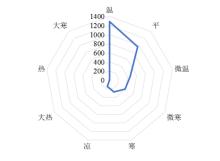
Fig.1
Radar chart of the frequency of the four properties in traditional Chinese medicine"
Fig.2
Radar chart of the frequency of the five flavours in traditional Chinese medicine"
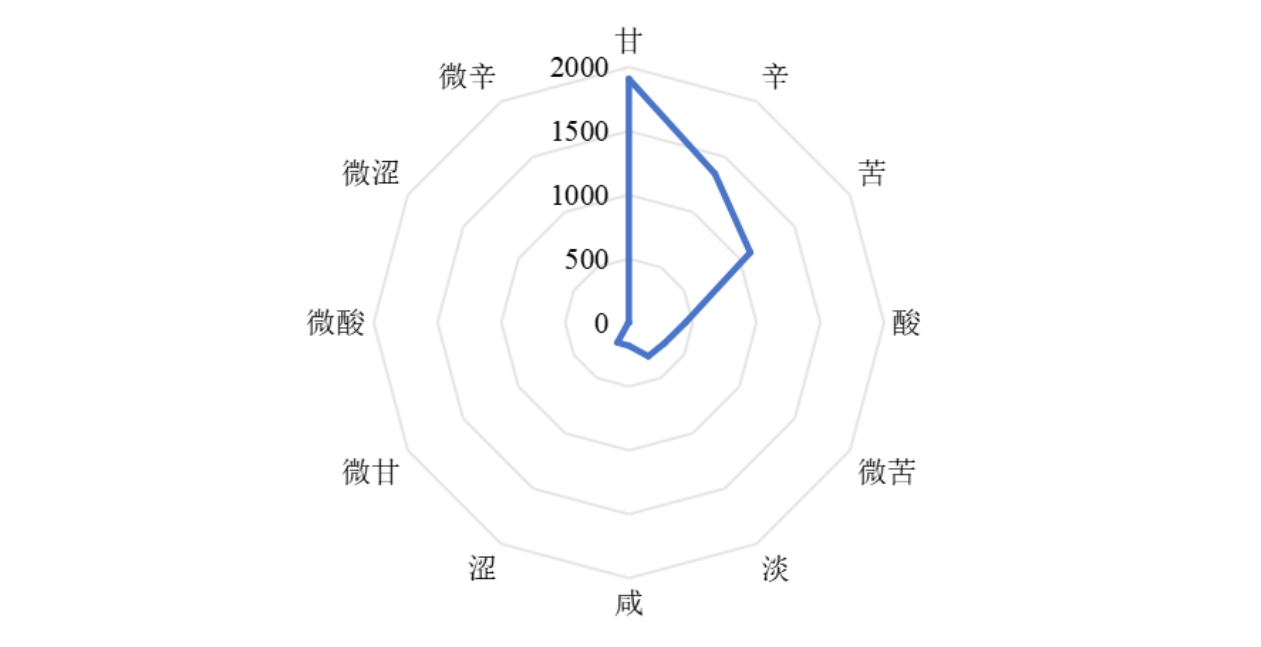
Fig.3
Radar chart of the frequency of meridial distribution in traditional Chinese medicine"
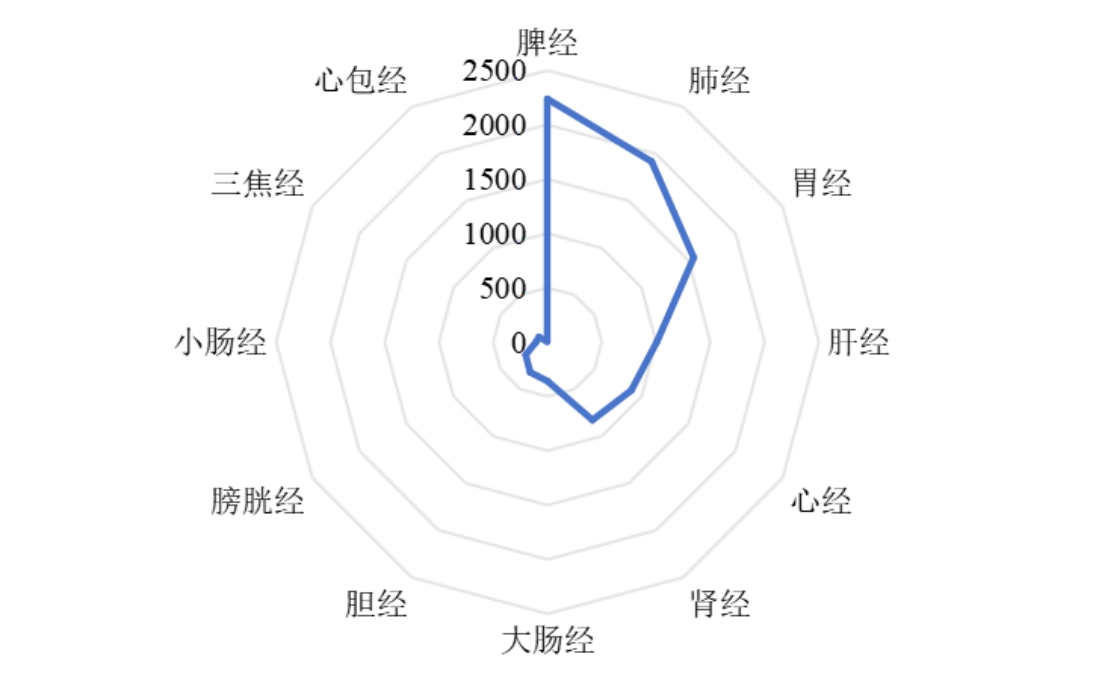
Table 2
Association rules between pairs of traditional Chinese medicines (top 30 by support)"
| 中药A | 中药B | 支持度(%) | A→B置信度(%) | B→A置信度(%) | 提升度(%) | 中药A | 中药B | 支持度(%) | A→B置信度(%) | B→A置信度(%) | 提升度(%) |
|---|---|---|---|---|---|---|---|---|---|---|---|
| 法半夏 | 茯苓 | 46.96 | 73.47 | 69.68 | 1.09 | 太子参 | 茯苓 | 30.00 | 67.65 | 44.52 | 1.00 |
| 麸炒白术 | 茯苓 | 45.22 | 67.53 | 67.10 | 1.00 | 太子参 | 麸炒白术 | 30.00 | 67.65 | 44.81 | 1.01 |
| 麸炒白术 | 法半夏 | 43.04 | 64.29 | 67.35 | 1.01 | 木香 | 麸炒白术 | 29.57 | 74.73 | 44.16 | 1.12 |
| 陈皮 | 麸炒白术 | 41.74 | 75.00 | 62.34 | 1.12 | 广藿香 | 焦山楂 | 29.13 | 77.01 | 50.76 | 1.34 |
| 陈皮 | 茯苓 | 41.30 | 74.22 | 61.29 | 1.10 | 葛根 | 焦山楂 | 28.70 | 75.00 | 50.00 | 1.31 |
| 焦山楂 | 茯苓 | 40.43 | 70.45 | 60.00 | 1.05 | 木香 | 茯苓 | 28.70 | 72.53 | 42.58 | 1.08 |
| 焦山楂 | 麸炒白术 | 40.00 | 69.70 | 59.74 | 1.04 | 焦山楂 | 木香 | 28.26 | 49.24 | 71.43 | 1.24 |
| 陈皮 | 焦山楂 | 38.26 | 68.75 | 66.67 | 1.20 | 木香 | 法半夏 | 27.83 | 70.33 | 43.54 | 1.10 |
| 陈皮 | 法半夏 | 38.26 | 68.75 | 59.86 | 1.08 | 葛根 | 茯苓 | 26.52 | 69.32 | 39.35 | 1.03 |
| 广藿香 | 葛根 | 37.39 | 98.85 | 97.73 | 2.58 | 广藿香 | 法半夏 | 26.09 | 68.97 | 40.82 | 1.08 |
| 葛根 | 木香 | 35.65 | 93.18 | 90.11 | 2.36 | 广藿香 | 茯苓 | 26.09 | 68.97 | 38.71 | 1.02 |
| 木香 | 广藿香 | 35.65 | 90.11 | 94.25 | 2.38 | 葛根 | 法半夏 | 26.09 | 68.18 | 40.82 | 1.07 |
| 太子参 | 焦山楂 | 31.74 | 71.57 | 55.30 | 1.25 | 太子参 | 陈皮 | 26.09 | 58.82 | 46.88 | 1.06 |
| 葛根 | 麸炒白术 | 30.87 | 80.68 | 46.10 | 1.20 | 太子参 | 木香 | 24.78 | 55.88 | 62.64 | 1.41 |
| 麸炒白术 | 广藿香 | 30.43 | 45.45 | 80.46 | 1.20 | 葛根 | 太子参 | 24.35 | 63.64 | 54.90 | 1.43 |
Table3
AssociationrulesbetweenpairsoftraditionalChinesemedicines(top30byconfidence)"
| 中药A | 中药B | A→B置信度(%) | B→A置信度(%) | 支持度(%) | 提升度(%) | 中药A | 中药B | A→B置信度(%) | B→A置信度(%) | 支持度(%) | 提升度(%) |
|---|---|---|---|---|---|---|---|---|---|---|---|
| 蜜麻黄 | 苦杏仁 | 100.00 | 67.74 | 18.26 | 3.71 | 甘草泡地龙 | 法半夏 | 91.89 | 23.13 | 14.78 | 1.44 |
| 前胡 | 苦杏仁 | 100.00 | 54.84 | 14.78 | 3.71 | 鸡内金 | 麸炒白术 | 91.30 | 13.64 | 9.13 | 1.36 |
| 龙骨 | 牡蛎 | 100.00 | 37.33 | 12.17 | 3.07 | 款冬花 | 苦杏仁 | 90.48 | 61.29 | 16.52 | 3.36 |
| 毛冬青 | 蜜麻黄 | 100.00 | 64.29 | 11.74 | 5.48 | 黄芩片 | 法半夏 | 89.66 | 17.69 | 11.30 | 1.40 |
| 毛冬青 | 苦杏仁 | 100.00 | 43.55 | 11.74 | 3.71 | 毛冬青 | 茯苓 | 88.89 | 15.48 | 10.43 | 1.32 |
| 蛤壳 | 法半夏 | 100.00 | 16.33 | 10.43 | 1.56 | 蜜麻黄 | 法半夏 | 88.10 | 25.17 | 16.09 | 1.38 |
| 广藿香 | 葛根 | 98.85 | 97.73 | 37.39 | 2.58 | 西洋参 | 牡蛎 | 86.96 | 26.67 | 8.70 | 2.67 |
| 毛冬青 | 法半夏 | 96.30 | 17.69 | 11.30 | 1.51 | 鸡内金 | 焦山楂 | 86.96 | 15.15 | 8.70 | 1.52 |
| 蛤壳 | 蜜麻黄 | 95.83 | 54.76 | 10.00 | 5.25 | 茯神 | 麸炒白术 | 85.71 | 23.38 | 15.65 | 1.28 |
| 蛤壳 | 苦杏仁 | 95.83 | 37.10 | 10.00 | 3.56 | 通草 | 法半夏 | 84.62 | 14.97 | 9.57 | 1.32 |
| 款冬花 | 法半夏 | 95.24 | 27.21 | 17.39 | 1.49 | 干石斛 | 牡蛎 | 84.00 | 28.00 | 9.13 | 2.58 |
| 广藿香 | 木香 | 94.25 | 90.11 | 35.65 | 2.38 | 苦杏仁 | 法半夏 | 83.87 | 35.37 | 22.61 | 1.31 |
| 前胡 | 蜜麻黄 | 94.12 | 76.19 | 13.91 | 5.15 | 麸炒枳实 | 麸炒白术 | 83.78 | 20.13 | 13.48 | 1.25 |
| 五味子 | 茯苓 | 94.12 | 20.65 | 13.91 | 1.40 | 甘草泡地龙 | 苦杏仁 | 83.78 | 50.00 | 13.48 | 3.11 |
| 葛根 | 木香 | 93.18 | 90.11 | 35.65 | 2.36 | 佛手 | 法半夏 | 83.33 | 13.61 | 8.70 | 1.30 |
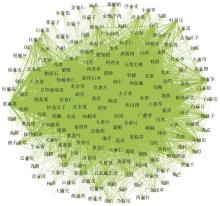
Fig.4
Complex network diagram of traditional Chinese medicine"
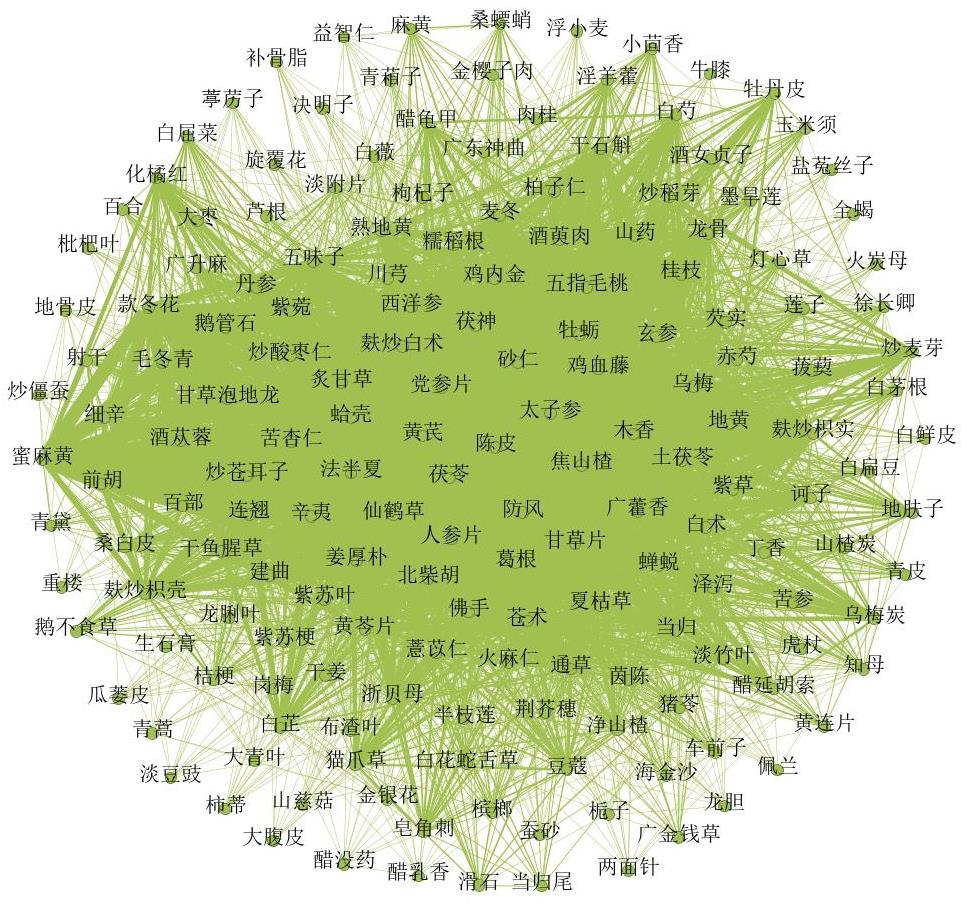
Table 4
Topological parameters of complex networks in traditional Chinese medicine"
| 参数 | 数值 |
|---|---|
| 节点个数 | 177 |
| 边个数 | 4 345 |
| 平均路径长度 | 1.724 |
| 平均节点度 | 49.096 |
| 网络直径 | 3 |
| 平均聚类系数 | 0.874 |
Fig.5
Complex network diagram of core traditional Chinese medicine"
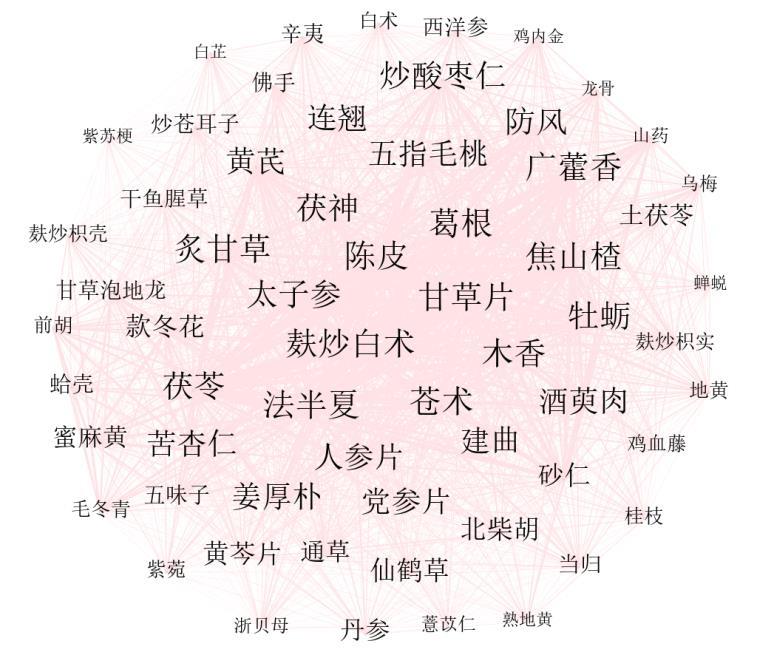
Table 5
Analysis of core traditional Chinese medicine (top 30 by frequency of use)"
| 中药 | 度中心性 | 接近中心性 | 介数中心性 | 中药 | 度中心性 | 接近中心性 | 介数中心性 |
|---|---|---|---|---|---|---|---|
| 甘草片 | 0.88 | 0.89 | 933.96 | 苦杏仁 | 0.60 | 0.72 | 263.14 |
| 茯苓 | 0.85 | 0.87 | 740.97 | 炙甘草 | 0.64 | 0.73 | 285.72 |
| 麸炒白术 | 0.81 | 0.84 | 600.12 | 人参片 | 0.67 | 0.75 | 376.63 |
| 法半夏 | 0.82 | 0.85 | 712.04 | 酒萸肉 | 0.57 | 0.70 | 165.75 |
| 焦山楂 | 0.77 | 0.81 | 476.75 | 炒酸枣仁 | 0.59 | 0.71 | 158.42 |
| 陈皮 | 0.78 | 0.82 | 493.75 | 山药 | 0.44 | 0.64 | 75.14 |
| 太子参 | 0.69 | 0.76 | 277.93 | 五指毛桃 | 0.59 | 0.71 | 176.71 |
| 木香 | 0.65 | 0.74 | 218.20 | 姜厚朴 | 0.61 | 0.72 | 244.69 |
| 葛根 | 0.66 | 0.75 | 271.35 | 茯神 | 0.59 | 0.71 | 186.79 |
| 广藿香 | 0.63 | 0.73 | 205.34 | 蜜麻黄 | 0.42 | 0.63 | 80.34 |
| 牡蛎 | 0.64 | 0.73 | 233.56 | 款冬花 | 0.41 | 0.63 | 51.33 |
| 砂仁 | 0.66 | 0.75 | 294.80 | 麸炒枳实 | 0.46 | 0.65 | 92.09 |
| 苍术 | 0.68 | 0.76 | 306.32 | 甘草泡地龙 | 0.37 | 0.61 | 29.78 |
| 防风 | 0.61 | 0.72 | 211.48 | 五味子 | 0.40 | 0.62 | 58.67 |
| 黄芪 | 0.57 | 0.70 | 148.60 | 前胡 | 0.38 | 0.62 | 51.77 |
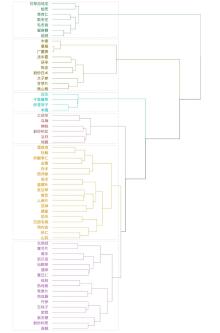
Fig.6
Results from hierarchical clustering of core traditional Chinese medicine"
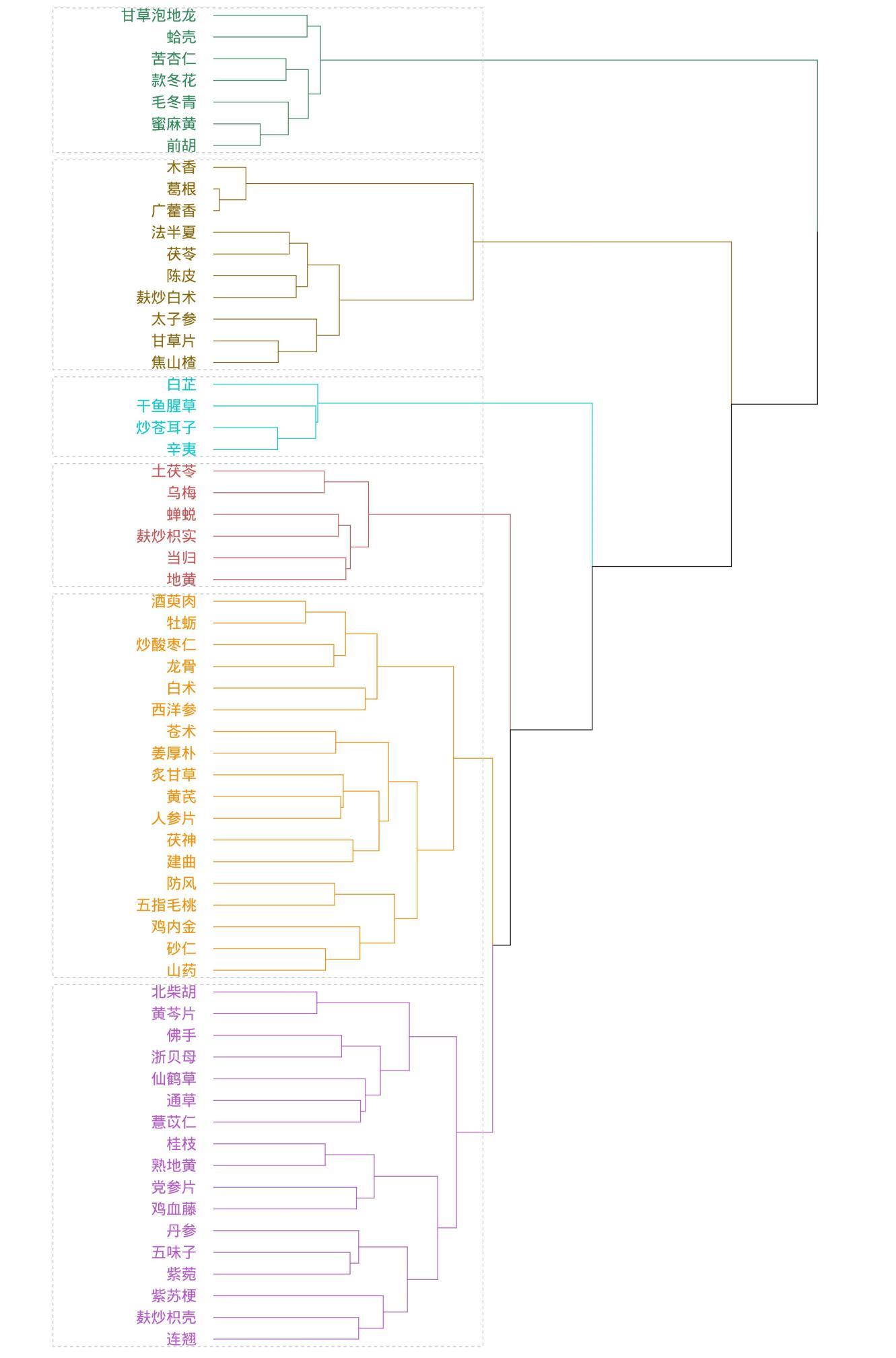
Table 6
Clustering results for 6 core traditional Chinese medicine groups"
| 类别 | 中药组成 |
|---|---|
| 类别1 | 太子参、茯苓、麸炒白术、木香、葛根、广藿香、法半夏、陈皮、焦山楂、甘草片 |
| 类别2 | 牡蛎、砂仁、苍术、防风、黄芪、炙甘草、人参片、酒萸肉、炒酸枣仁、山药、五指毛桃、姜厚朴、茯神、建曲、龙骨、鸡内金、西洋参、白术 |
| 类别3 | 蜜麻黄、苦杏仁、前胡、款冬花、甘草泡地龙、毛冬青、蛤壳 |
| 类别4 | 麸炒枳实、地黄、乌梅、当归、土茯苓、蝉蜕 |
| 类别5 | 五味子、党参片、黄芩片、连翘、通草、北柴胡、佛手、麸炒枳壳、桂枝、鸡血藤、丹参、仙鹤草、熟地黄、浙贝母、薏苡仁、紫菀、紫苏梗 |
| 类别6 | 干鱼腥草、辛夷、炒苍耳子、白芷 |
Fig.7
Visualization of modularity analysis of compatible traditional Chinese medicine"
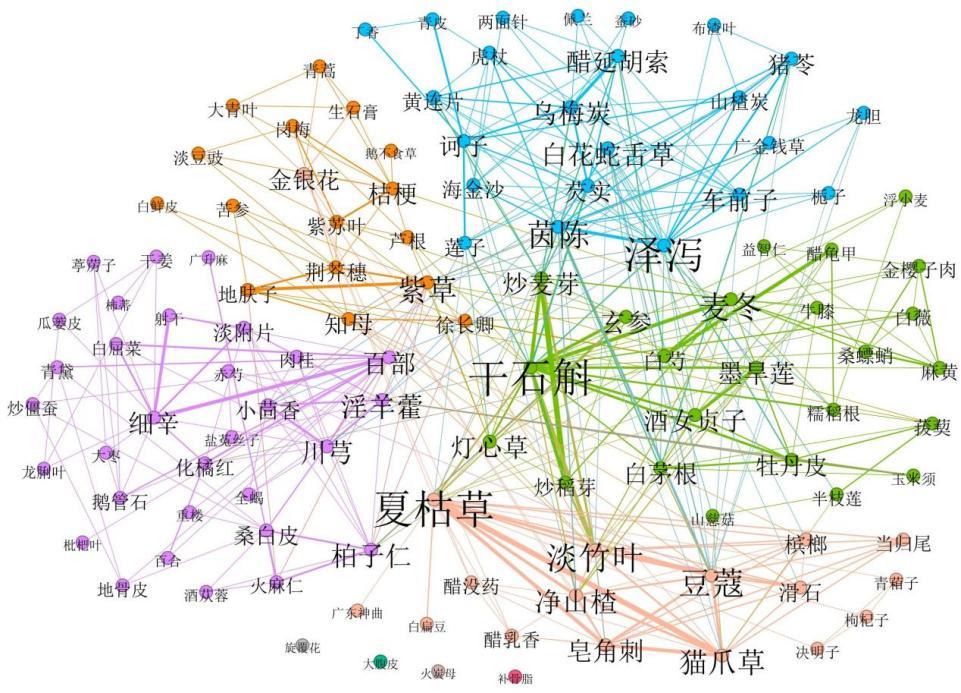
Table 7
Modularity analysis of compatible traditional Chinese medicine"
| 社团 | 中药组成 |
|---|---|
| 社团1 | 干石斛、玄参、灯心草、酒女贞子、墨旱莲、麦冬、牡丹皮、炒麦芽、白芍、白茅根、炒稻芽、白薇、菝葜、麻黄、桑螵蛸、金樱子肉、糯稻根、牛膝、玉米须、浮小麦、醋龟甲、半枝莲、山慈菇、益智仁 |
| 社团2 | 淫羊藿、川芎、柏子仁、小茴香、化橘红、淡附片、赤芍、肉桂、火麻仁、百部、细辛、全蝎、桑白皮、白屈菜、盐菟丝子、酒苁蓉、射干、鹅管石、百合、青黛、炒僵蚕、地骨皮、重楼、干姜 |
| 社团3 | 泽泻、茵陈、莲子、猪苓、白花蛇舌草、芡实、车前子、醋延胡索、乌梅炭、广金钱草、诃子、黄连片、海金沙、山楂炭、龙胆、栀子、虎杖、佩兰、布渣叶、两面针、蚕砂、青皮、丁香 |
| 社团4 | 紫草、知母、徐长卿、芦根、地肤子、紫苏叶、荆芥穗、桔梗、苦参、岗梅、淡豆豉、白鲜皮、大青叶、青蒿、生石膏、鹅不食草 |
| 社团5 | 夏枯草、豆蔻、淡竹叶、净山楂、猫爪草、皂角刺、槟榔、滑石、当归尾、金银花、醋没药、醋乳香、枸杞子、决明子、青葙子、白扁豆、广东神曲 |
| [1] | Sugiyanto M, Gosal S, Kosim A, et al. Impact of the source of hematopoietic stem cells on immune reconstitution after transplantation: a systematic review[J]. Eur J Haematol, 2023, 111(1): 4-14. |
| [2] | DeFilipp Z, Alousi AM, Pidala JA, et al. Nonrelapse mortality among patients diagnosed with chronic GVHD: an updated analysis from the Chronic GVHD Consortium[J]. Blood Adv, 2021, 5(20): 4278-4284. |
| [3] | Diep PP, Rueegg CS, Burman MM, et al. Graft-versus-host-disease and health-related quality of life in young long-term survivors of cancer and allogeneic hematopoietic stem cell transplantation[J]. J Adolesc Young Adult Oncol, 2023, 12(1): 66-75. |
| [4] | Fleischer T, Chang TT, Yen HR. Post-hematopoietic stem cell transplantation in patients with hematologic disorders: Chinese herbal medicine for an unmet need[J]. J Integr Med, 2016, 14(5): 322-335. |
| [5] | 国家药典委员会. 中华人民共和国药典-一部: 2020年版[M]. 北京: 中国医药科技出版社, 2020. |
| [6] | 南京中医药大学. 中药大辞典[M]. 2版. 上海: 上海科学技术出版社, 2014. |
| [7] | 国家中医药管理局. 中华本草[M]. 上海:上海科学技术出版社, 1999. |
| [8] | 《全国中草药汇编》编写组. 全国中草药汇编[M]. 北京:人民卫生出版社, 1975. |
| [9] | 但文超,赵国桢,何庆勇,等.中医药处方数据挖掘的常见问题辨析与展望[J].中国中药杂志,2023,48(17):4812-4818. |
| [10] | Seidman SB. Network structure and minimum degree[J]. Soc Netw, 1983, 5(3): 269-287. |
| [11] | 何佳怡, 谢佳东, 胡晨骏, 等. 基于图神经网络的中药聚类方法研究[J]. 世界科学技术-中医药现代化, 2024,26(11): 2988-2995. |
| [12] | Blondel V, Guillaume JL, Lambiotte R. Fast unfolding of communities in large networks: 15 years later[J]. J Stat Mech, 2024(10): 10R001. |
| [13] | Girvan M, Newman MJ. Community structure in social and biological networks[J]. Proc Natl Acad Sci USA, 2002, 99(12): 7821-7826. |
| [14] | 任晓龙,吕琳媛.网络重要节点排序方法综述[J].科学通报,2014,59(13):1175-1197. |
| [15] | 金·李杲. 脾胃论[M]. 北京: 中国中医药出版社, 2019. |
| [16] | 江育仁.脾健不在补贵在运:运脾法在儿科临床的实践意义[J].中医杂志,1983(1):4-6. |
| [17] | 黄宝仪,易立琛,李平甘,等.100例造血干细胞移植后患儿中医证候分布特点的潜在类别及隐结构分析[J].中医杂志,2025,66(17):1783-1792. |
| [18] | 宋·钱乙. 小儿药证直诀[M]. 北京:中国医药科学技术出版社, 2021. |
| [19] | 闵思明, 赵晓瑶, 陈赛红, 等. 太子参参须多糖对免疫抑制小鼠的免疫调节作用研究[J]. 动物医学进展, 2020, 41(8): 23-28. |
| [20] | 赵佳梅,杜蓥蓥,曾丽,等.太子参多糖对OVA免疫小鼠肠道免疫应答能力的影响[J].福建农林大学学报(自然科学版),2024,53(6):772-778. |
| [21] | 谢骏,王媛媛,李聚鑫,等.茯苓多糖调控Rho-ROCK信号通路对心肌缺血再灌注损伤大鼠心肌细胞凋亡的影响和机制研究[J].中国中药杂志,2023,48(23):6434-6441. |
| [22] | 董永杰,董静,贾辉,等.茯苓酸调节VEGFC/VEGFR3信号通路抑制结直肠癌免疫逃逸[J].中国老年学杂志,2024,44(23):5840-5845. |
| [23] | Zhao H, Liu T, Yang CE, et al. Poricoic acid A attenuates renal fibrosis by inhibiting endoplasmic reticulum stress-mediated apoptosis[J]. Braz J Med Biol Res, 2024, 57: e14249. |
| [24] | 张森, 豆晓霞, 刘晓东, 等. 白术多糖对动物免疫调节作用研究进展[J]. 饲料工业, 2024, 45(19): 20-25. |
| [25] | Chen C, Sun Y, Wang Z, et al. Pinellia genus: a systematic review of active ingredients, pharmacological effects and action mechanism, toxicological evaluation, and multi-omics application[J]. Gene, 2023, 870: 147426. |
| [26] | 清·沈金鳌. 杂病源流犀烛[M]. 李占永,李晓林校注. 北京: 中国中医药出版社, 1994. |
| [27] | 谢铱子,张欣欣,黄慧婷,等.特发性肺纤维化特征基因和靶向中药的探索与验证[J].中草药,2024,55(21):7381-7398. |
| [28] | 黄帝内经·素问[M]. 周鸿飞,范涛点校.郑州: 河南科学技术出版社, 2017. |
| [29] | 黄帝内经·灵枢[M]. 太原: 山西科学技术出版社, 2019. |
| [30] | 清·孙星衍,孙冯翼. 神农本草经[M]. 太原: 山西科学技术出版社, 2018. |
| [31] | 明·李时珍. 本草纲目[M]. 张守康主校. 北京: 中国中医药出版社, 1998. |
| [1] | Lizheng JIN, Jiapei LIN, Hanyu SUN, Guangju HUANG. Research progress on influencing factors for childhood asthma control [J]. Chinese Pediatrics of Integrated Traditional and Western Medicine, 2026, 18(2): 104-110. |
| [2] | Qing YANG, Jingnan XUE, Liujin JIA. Experience of Professor Jia Liujin in treating pediatric pneumonia with dyspnea and cough [J]. Chinese Pediatrics of Integrated Traditional and Western Medicine, 2026, 18(2): 111-115. |
| [3] | Zhe ZHOU, Huina LU, Ming ZHANG, Ling DONG. Research on the clinical experience of Professor Xu Rongqian in treating children with cough variant asthma [J]. Chinese Pediatrics of Integrated Traditional and Western Medicine, 2026, 18(2): 116-121. |
| [4] | Xuting WANG, Peng ZHOU. Research status of specific immunotherapy for childhood asthma [J]. Chinese Pediatrics of Integrated Traditional and Western Medicine, 2026, 18(2): 122-127. |
| [5] | Minli GUAN, Xiaolin GAO. Advances in diagnosis and treatment of pediatric mesenteric lymphadenitis based on integrated traditional Chinese and western medicine [J]. Chinese Pediatrics of Integrated Traditional and Western Medicine, 2026, 18(2): 128-132. |
| [6] | Lei XU, Shi ZHANG, Jiujun QIU, Wenjing ZHANG, Shaomin LIANG, Lin HOU, Hong WANG. Common misconceptions and treatment strategies in occupational therapy for children with cerebral palsy [J]. Chinese Pediatrics of Integrated Traditional and Western Medicine, 2026, 18(2): 133-136. |
| [7] | Shihui TANG, Xuefeng WANG, Kexin ZHANG. Professor Wang Xuefeng's exploration in the clinical experience in pediatric pneumonia with dyspnea and cough based on the theory of "What is within manifests without" [J]. Chinese Pediatrics of Integrated Traditional and Western Medicine, 2026, 18(2): 137-140. |
| [8] | Meifang CHEN, Jian ZHENG. Professor Zheng Jian's experience in treating refractory nephrotic syndrome in children based on the principle of "phased collaboration and sequential synergy" [J]. Chinese Pediatrics of Integrated Traditional and Western Medicine, 2026, 18(2): 141-146. |
| [9] | Hang YANG, Mingzhang LI, Xi LI, Xinchen WU, Xiangjuan SUN. Application of the "aromatic orifice-opening" method in pediatric pulmonary and nasal diseases [J]. Chinese Pediatrics of Integrated Traditional and Western Medicine, 2026, 18(2): 147-151. |
| [10] | Yuhan WU, Dan YUAN, Xinxin HUANG, Yinglong CHEN, Yingying KE, Qian LIN, Shiyi ZENG. Exploration of Professor Yuan Dan's experience in treating infantile enuresis from the perspective of blood stasis [J]. Chinese Pediatrics of Integrated Traditional and Western Medicine, 2026, 18(2): 152-156. |
| [11] | Xuejiao WANG, Chen SHEN, Miao YU, Yiwen GAO, Heng LI. Clinical efficacy analysis of foot bath with Jiebiao Toure decoction combined with meridian scraping in the treatment of exogenous fever (wind-heat type) in children [J]. Chinese Pediatrics of Integrated Traditional and Western Medicine, 2026, 18(2): 168-173. |
| [12] | Yingying WU, Jinming LI, Caixiao SHI, Qing SHANG, Xiangli WANG, Liang HAN. Observation on the efficacy of pelvic floor magnetic stimulation combined with bladder function training in children with neurogenic bladder after spinal cord injury [J]. Chinese Pediatrics of Integrated Traditional and Western Medicine, 2026, 18(2): 174-179. |
| [13] | Enhui ZHANG, Linlin WANG, Bo LIU. Analysis of differences in vitamin A, D and E levels in preschool children with allergic diseases and their correlation with risk of severe pneumonia [J]. Chinese Pediatrics of Integrated Traditional and Western Medicine, 2026, 18(2): 180-184. |
| [14] | Guining LU, Shunhuan MAI, Xiaojin OUYANG, Guochun HUANG, Yajun WANG, Yuejian ZHANG, Tingting PAN. Study on the application effect of standardized medical record system combined with Internet-based management model in childhood asthma control [J]. Chinese Pediatrics of Integrated Traditional and Western Medicine, 2026, 18(2): 93-97. |
| [15] | Jiongnan WEN, Yuansha WANG, Mengyi XU, Yi LÜ, Haixia LI. Exploring the mechanism of action of Buzhong Yiqi decoction in the treatment of pediatric combined allergic rhinitis and asthma syndrome based on network pharmacology and molecular docking technology [J]. Chinese Pediatrics of Integrated Traditional and Western Medicine, 2026, 18(2): 98-103. |
| Viewed | ||||||
|
Full text |
|
|||||
|
Abstract |
|
|||||
